SHAREing’s organisation
SHAREing in a nutshell:
- Working groups identify tasks that they would like to see realised
- The consortium approves these tasks and publishes them
- RTPs pitch their projects (typically 1-3 months at 100% FTE); in each project, they have to flag which and how they meet the task objectives
- SHAREing commissions the projects
Working groups: how we identify what SHAREing should provide
SHAREing is organised into various working groups, each responsible for a few work packages. The groups’ core job is to run scoping exercises: the groups brainstorm which types of activities SHAREing should fund in the future to accomplish its vision. Eventually, the working groups write task descriptions that describe what want to see implemented to push the work package’s agenda further.
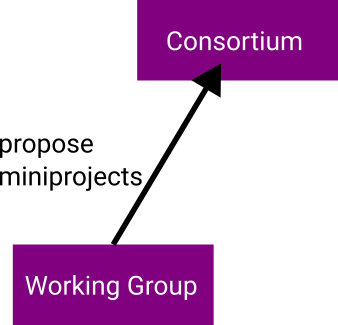
Work groups are open to the public, i.e. people can join the virtual meetings and make proposals what SHAREing should deliver. The virtual meetings of all working groups are published on SHAREing’s webpage. Participating in working group meetings give RTPs and acadmics not only the opportunity to decide upon SHAREing’s direction of travel, they can also propose tasks that they consider to be important and for which they would like to bid later on.
Approval
The working groups’ task descriptions are handed over to the SHAREing consortium meetings (not open to public). It is the job of the consortium to decide if tasks align with the SHAREing vision. Once the consortium approves a task, the task is made public.
Calls for miniprojects
RTPs or groups of RTPs can submit miniproject proposals to SHAREing. These miniprojects typically span 1-3 months and are funded up to 100% FTE - although many bids propose run for three months but only at a reduced workload, so it fits to other commitments of the group making the proposal. Bids typically comprise an
- estimate of the arising costs,
- envisaged timeframe,
- they describe why and how the work is realistic,
- they clearly write down what will be delivered.
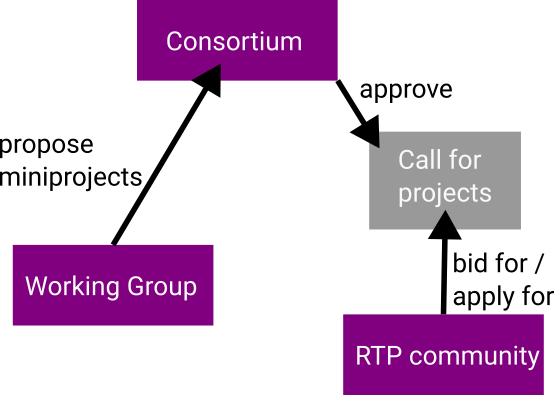
Some projects deliver actual reports or training material, others comprise the organisation of events or questionnaires, case studies, or general services to the community. The most important thing is each bid has to point out how it addresses at least one of the tasks that the working groups have identified. Sole blue sky proposals without a clear relation to what SHAREing considers to be important have limited chance to be funded:
Miniproject selection
The bids for miniprojects are collected by SHAREing’s admin office and reviewed on a rolling base. To a certain degree, we do FCFS. The reviewers (typically coming from the SHAREing consortium, taking conflicts of interest into account) assess the project bids along three criteria:
- Value for money
- Feasibility
- Fit to SHAREing’s published tasks
Eventually SHAREing commissions projects, i.e. tells the proposing team the go ahead.
Miniproject wrap-up
Once commissioned, the RTP teams complete their work and hence make a contribution towards SHAREing’s overall vision. Once a miniproject submits their deliverables (often going hand in hand with an update of SHAREing’s webpage), our office triggers the cash flow. Eventually, we ask the working group to assess if the addressed task from the task list now is covered and if we should remove it from our list. This way, insights and work can be taken into account as we scope new tasks.
External review
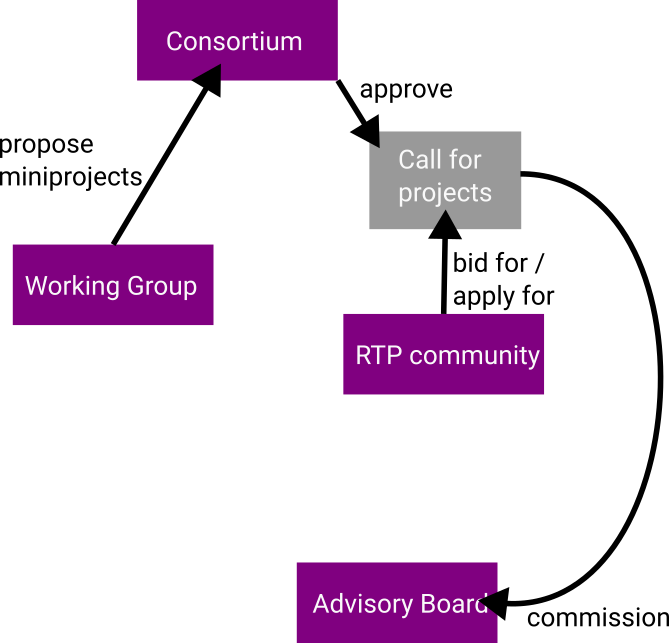
Our Advisory board is informed about the set of idenified tasks as well as commissioned miniprojects. The advisory board makes recommendations to the SHAREing consortium which are then passed on to the working groups, such that Advisory Board ideas are taken into account for future task descriptions.